
History
Background
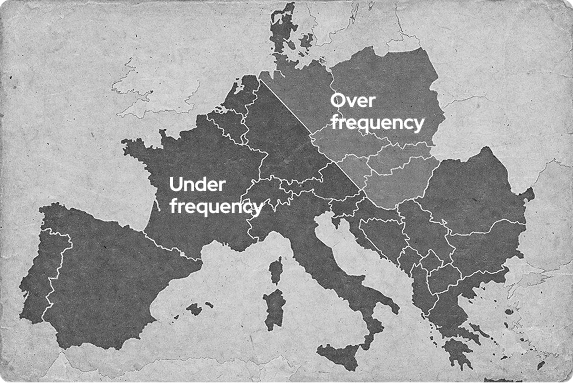
On 4 November 2006, Europe faced one of the largest electrical power disruptions in modern history, when more than 15 million consumers were left without electricity and the synchronous area of Continental Europe was divided into three sub-areas. Immediately after this incident the European Commission, together with TSOs, started looking into ways to improve communication and coordination between TSOs in order to tackle challenges in operational planning processes and to ensure the security of electricity supply.
The Outcomes of the 2006 European blackout investigation, as well as continual increase of cross-border exchanges and variable power from Renewable Energy Sources (RES), were the main reasons for some EU TSOs to improve operational coordination by establishing Regional Security Coordination Initiatives (RSCIs). In 2008, two RSCIs were established on voluntary basis – Coreso in West Europe and TSC in Central Europe. RSCIs were the forerunners of today’s Regional Coordination Centres (RCCs), while Coreso and TSC are the pioneers in terms of regional coordination between TSOs in Continental Europe.
The establishment of SCC
Following the form defined by ENTSO-E’s Policy Paper “Core strategy for TSO Coordination” and European network codes and guidelines, the need to improve mutual coordination in the region of South East Europe (SEE) was first recognized by the TSOs of Serbia (EMS AD) and Montenegro (CGES AD), as well as by the Independent System Operator (ISO) from Bosnia and Herzegovina (NOSBiH). These 3 national entities established the Security Coordination Centre SCC Ltd. Belgrade on 15 June, 2015.
SCC was the first RSC(I) in the SEE region, as well as the third established RSC(I) in Europe. SCC has successfully started its operations on 1 August, 2015. – just one and half month after the establishment.
Evolution of RCCs
On 10 December 2015, ENTSO-E TSOs signed a Multilateral Agreement on Participation in RSCIs (RSCI MLA) that required all TSOs to participate in RSCs in order to receive five core services from them. This event caused the creation of two new RSCs during 2016: Baltic RSC and Nordic RSC (which covered regions of the same name).
In the middle of 2017, RSCs are recognised by EU law, when the System Operation Guideline, one of the EU network codes, was implemented.
In May 2020, SEleNe CC was established by ESO EAD, IPTO, TERNA SpA and Transelectrica.
As of 1 July 2022, RSCs were replaced by Regional Coordination Centres (RCCs), established under the Electricity Regulation (EU) 2019/943, part of the Clean Energy Package, with an expanded scope of responsibilities.