
IGMs Validation & CGM Creation
Individual Grid Model (IGM) is “a data set describing power system characteristics
(generation, load and grid topology) and related rules to change these characteristics during
capacity calculation, prepared by the responsible TSOs”, according to the definition from
The Common Grid Model Methodology (CGMM).
IGMs are statical mathematical models, created to represent forecasted state of TSO power system for defined timestamp and given forecast time horizon (intraday – several hours ahead, day ahead, two days ahead, etc.).
After creation by TSOs, IGMs are provided to RCCs in order to perform its validation (checking for syntax and semantics errors). If some discrepancies from the predefined rules are detected, TSOs are informed about these issues via Quality Assessment Service (QAS) portal, so TSOs could provide expected corrections of IGMs.
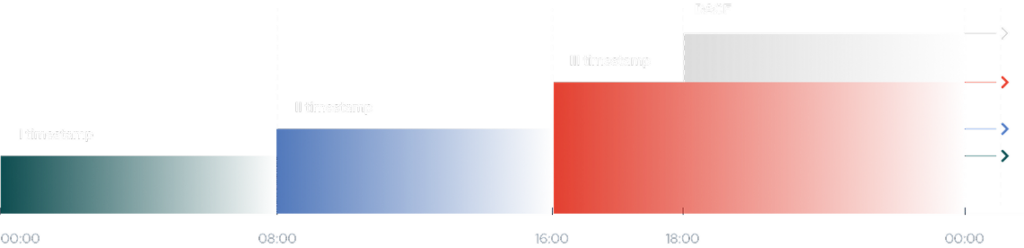
IDCF – Intraday Congestion Forecast
Performed three times for 8 upcoming hours.
DACF – Day Ahead Congestion Forecast
Performed every day for all hours of the upcoming day.
D2CF – Two Days Ahead Congestion Forecast
Performed every Monday for all hours of the Wednesday.*
*This process is still in dry run phase, but full implementation will include every day procedure for all hours of day after tomorrow.
CGM CREATION
Three operational procedures
After validation and correction of IGMs, the process of merging of IGMs is launched. The result of this process is Common Grid Model (CGM) on Continental Europe level. CGM is basis for all other RCC services, since all of them include load flow calculations. Based on the collected IGMs, the CGMs of Continental Europe are created for all desired upcoming hours.
Beside IGMs, for creation of CGMs, forecasted net positions from all TSOs are required. Net position represents the netted sum of electricity exports and imports for each market time unit for a bidding point.
CGMs created by SCC are timely delivered to its TSO service users using a predefined secure way of communication. Creation of CGMs in SCC is performed in software Enterprise Transmission Network Analyser (eTNA), where the user can find all needed information and reports about executed processes.
Currently IGMs and CGMs are created respecting the rules of UCT data exchange format – the data are contained in an unformatted standard US ASCII file, which is divided into blocks in which determined data (nodes, lines, transformers, etc.) are put successively in a defined manner. However, ever growing requirements for RCC services, and the need to improve mathematical modelling of system elements (e.g. High Voltage Direct Current cables, or 3 windings transformers), introduced new standard for exchanging information between TSOs and RCCs.
Common Grid Model Exchange Standard (CGMES) a technical specification based on IEC Common Information Model (CIM) family of standards. The purpose of CGMES is to define the interface between ENTSO-E members’ software in order to exchange power system modelling information as required by the ENTSO-ETSOs business processes.
DATA FORMAT
CGMES
CGMES PROFILES
Mandatory exchange envelope
In general, the CGMES defines a set of rules and/or requirements which are mandatory for achieving interoperability with the CGMES and for satisfying the business processes. Grid model exchange is a complex process covering a variety of use cases, which include the exchange of following CGMES profiles:
Equipment (EQ) profile
Contains power system equipment data information.
Topology (TP) profile
Contains topology related information for the grid elements.
Power system state variables (SSV) profile
Contains the results from initial load flow simulation of the system.
Steady state hypothesis (SSH) profile
Valid for newer standards and provides information on load and generation values as well as other input parameters necessary to perform load flow simulations.
Additionally, IGMs presented in CGMES could contain information related to dynamics, diagram layout and geographical location for elements in the power system. In order to establish secure and optimal continuous exchange of sensitive operational planning data between TSOs and RCCs, development of ENTSO-E private communication platform and network is in progress.
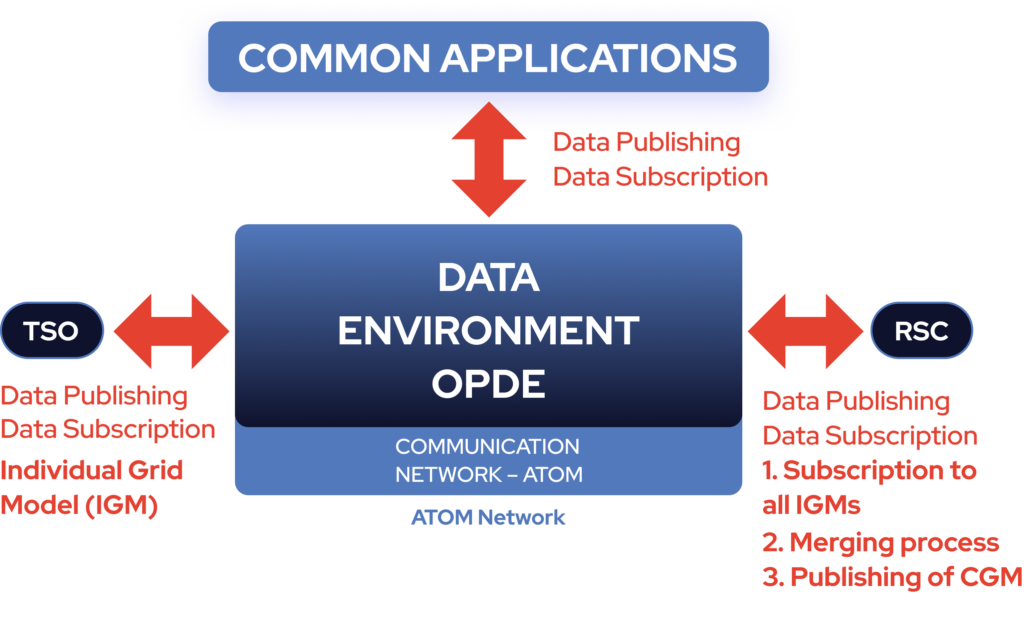
OPERATIONAL PLANNING DATA ENVIRONMENT
OPDE
The Operational Planning Data Environment (OPDE) is a digital platform that connects the different TSOs to central elements and vice versa. It is designed on the basis of a layered architecture consistent with the Smart Grid Architecture Model. The OPDE will see the development of central business apps for usage across TSOs as a first step, which could be open at a later stage to other stakeholders. The OPDE is the central layer: a standard middleware integration layer. The bottom layer is composed of a dedicated communication network called Physical Communication Network (PCN) on which the OPDE is running for high security and service levels.