
CGMA Process
Common Grid Model Alignment (CGMA) process is one of the additional RCC services, which can be defined as a set of procedures by which the initial estimates of net positions are revised such that the resulting set of net positions is balanced.
Net position represents the netted sum of electricity exports and imports for each market time unit for a bidding zone. When no market schedules are available, TSOs will typically base their Individual Grid Model (IGM) on an estimate of the net position which, in the first instance, they are free to determine by themselves. However, TSOs collectively have to respect a critical consistency requirement – all net positions within an interconnected system have to sum to zero because the sum of exports has to be equal to the sum of imports. When this consistency requirement is met, the net positions are referred to as “balanced” and the IGMs are said to be “aligned”. Unless this condition is fulfilled, it is not possible to merge the IGMs from all TSOs into the Common Grid Model (CGM).
Establishing balanced net positions is, in principle, straightforward for those timeframes for which schedule data are available (i.e. day-ahead and intraday). However, for timeframes for which schedules are not available (from two-days ahead up to year-ahead), balanced net positions have to be established using CGMA process.
Three phases of the CGMA process
Pre-processing
Each TSO provides its Pre-Processing
Data (PPD) to the CGMA platform which is operated by one or more Alignment Agents.
Processing
The CGMA platform redistributes the preliminary area net positions across all bidding zones, until they sum up to zero and calculates the CGMA results.
Post-processing
The final reference program should be used for creation of IGMs by TSOs, and subsequently in CGM merging process by RCCs as reference for balanced CGM.
Market & System Forecast
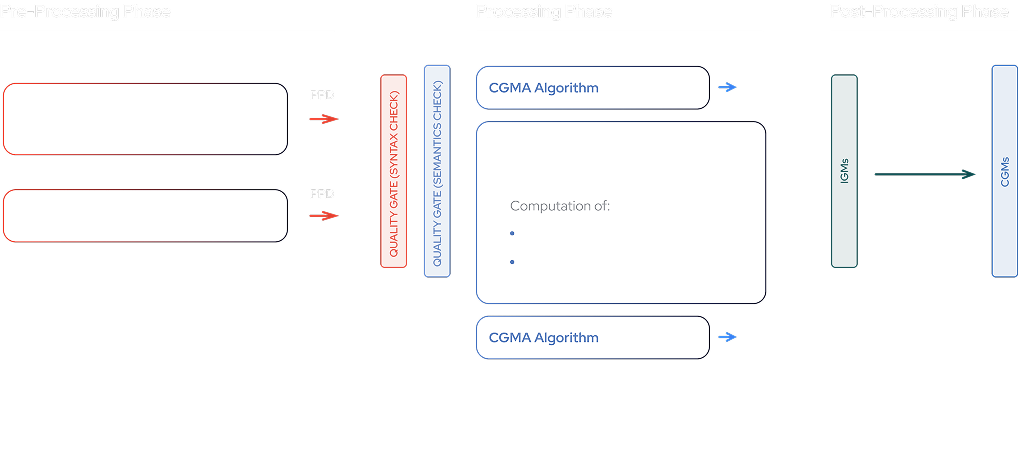
During the pre-processing phase each TSO provides its Pre-Processing Data (PPD) to the CGMA platform which is operated by one or more Alignment Agents. The Alignment Agents are actually Regional Coordination Centres (RCCs) so they are responsible for completing a number of tasks related to the CGMA process on behalf of the TSOs. The PPD should correspond to the TSO’s best forecast and to include:
PRE-PROCESSING DATA
The Alignment Agents
- preliminary area net position (mandatory)
- feasibility range (mandatory)
- preliminary gross DC flows (mandatory for optimisation areas linked to another optimisation area in a different synchronous area by DC link) at the exporting end
- maximum gross DC flows (export/import) (mandatory for optimisation areas linked to another optimisation area in a different synchronous area by DC link) at the exporting end
- absolute minimum and/or maximum area net position (optional)
- maximum AC border flow (export/import) (optional)
During the processing phase, the CGMA platform redistributes the preliminary area net positions across all bidding zones, until they sum up to zero and calculates the CGMA results, which consist of a set of:

PROCESSING DATA
Preliminary area net positions
- balanced area net positions
- balanced area AC net positions
- indicative AC flows per electrical border
- balanced gross DC flows at the exporting end
The results are provided by CGMA platform in two larger parts. The first part represents the core CGMA process ending with the provision of the balanced net positions and balanced gross flows on all (unsplit) DC links and it is called initial reference program. The second part supports the external pole splitting and loss calculation for TSOs connected to DC links. It ends with the provision of the final reference program containing balanced net positions and balanced flows on DC links considering poles and losses.
During the post-processing phase the final reference program should be used for creation of IGMs by TSOs, and subsequently in CGM merging process by RCCs as reference for balanced CGM.
POST-PROCESSING DATA
Creation of IGMs
As Alignment Agent for its service users, SCC is acting as mediator between TSOs and CGMA platform by performing following roles/services:
- submission of input data on behalf of TSOs or updating the values directly on CGMA platform,
- delivery of aligned exchange programs as the final output of CGMA process using the original format and additional one adjusted for the automatic usage of TSOs’ IGM creation tools
- updating Master Data on TSOs request
- additional operations using CGMA platform when needed